About henna
An ancient art, made by hand
Henna has marked weddings, festivals and new beginnings for thousands of years. Here is where it comes from, how Nazia makes her paste, and how to get the deepest stain from your design.
History
A tradition thousands of years old
Henna comes from a small flowering shrub, Lawsonia inermis, that grows in the hot, dry regions of North Africa, the Middle East and South Asia. People have used its leaves to colour skin, hair, nails and even fabric for thousands of years. Traces of henna have been found on the hair and nails of ancient Egyptian mummies.
As trade routes spread, so did henna. It became part of celebrations across India, Pakistan, the Arab world, Persia and North Africa, each region developing its own style: flowing florals and paisleys, bold geometric patterns, fine lace-like lattice.
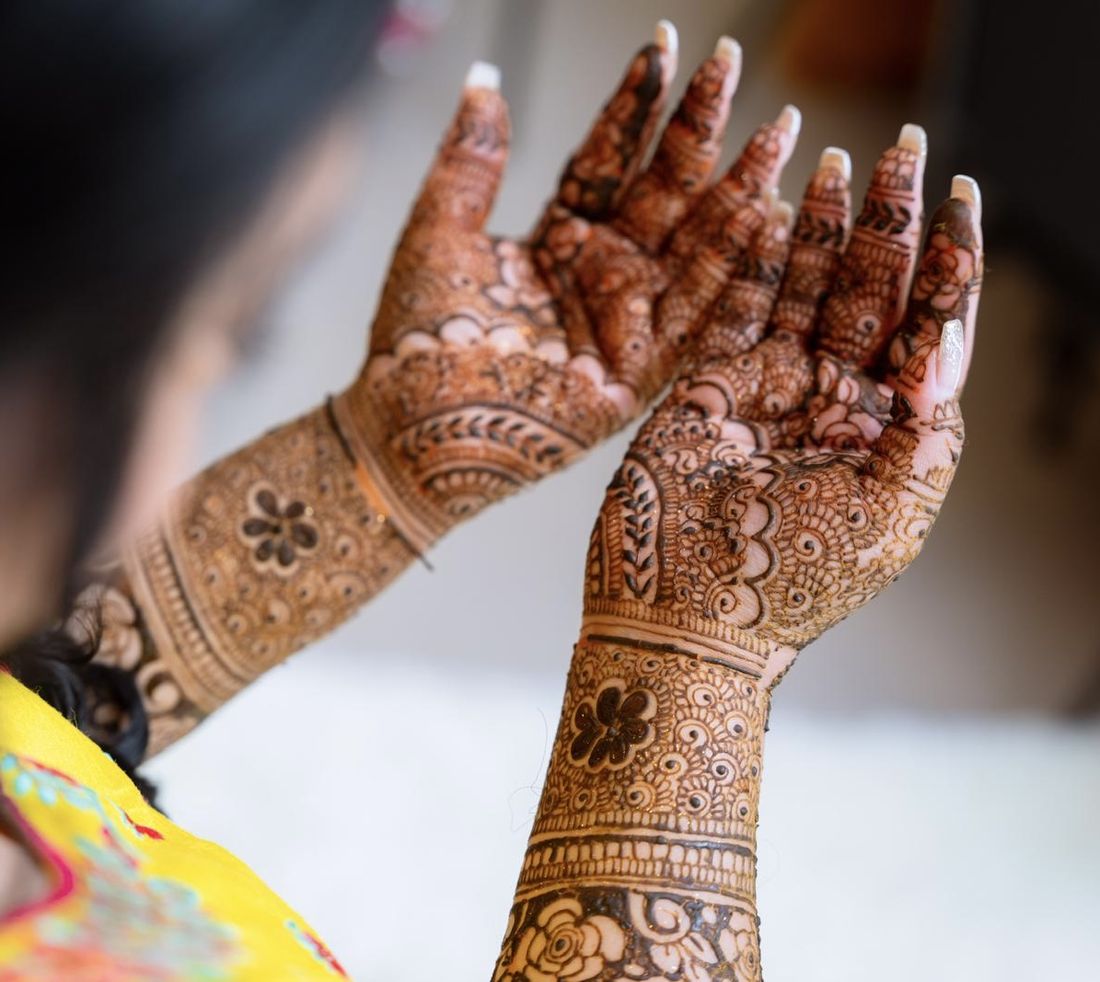
In South Asia it is known as mehndi, and the mehndi night before a wedding is one of the most joyful parts of the celebrations. The bride's hands and feet are covered in intricate designs, often with her partner's initials hidden in the pattern. Many families believe that the darker the stain, the stronger the love and blessings for the marriage.
Today henna is loved around the world for Eid, Diwali, Karva Chauth, baby showers, bachelorettes and birthdays, as a temporary, natural form of body art.
How it's made
From leaf to cone
Harvest
Leaves of the henna shrub, Lawsonia inermis, are picked. The dye molecule, lawsone, is strongest in young leaves grown in hot, dry climates.
Dry & sift
The leaves are dried out of direct sun, ground and sifted several times until the powder is as fine as flour. Fine powder gives the smooth, crisp lines bridal work needs.
Mix
The powder is mixed with lemon juice, a little sugar and pure essential oils. No chemicals, dyes or preservatives are added.
Rest
The paste rests for several hours so the lawsone releases from the leaf. This dye release is what makes a deep stain possible.
Cone
The ready paste is strained and rolled into small cones for fine, controlled lines. Natural paste is fresh, so it is kept frozen until the day of use.
Nazia started making her own paste more than twenty years ago, because she couldn't find henna without chemicals. Every cone she uses is still mixed by hand.
Aftercare
Caring for your henna
Follow these steps from Nazia for a dark, long-lasting stain.
Leave it on for 8 to 12 hours
The longer the paste stays on your skin, the deeper the stain. Overnight is best.
Seal it
Gently dab a lemon and sugar mixture, or a little Vicks VapoRub, on top of the dried paste. It acts as a sealant, keeps moisture in and helps the colour darken.
Don't wrap it
Avoid wrapping your hands or wearing gloves over fresh henna.
Scrape, don't wash
The next day, scrape the dried paste off. Don't rinse it off with water.
Keep it dry for 48 hours
For 48 hours after scraping, avoid water and soap on the design. If you must, wear disposable gloves.
What to expect
When you first scrape off the paste, the stain is bright orange. Over the next 24 to 48 hours it deepens to a rich reddish brown. Palms and fingertips usually stain darkest. The design fades gradually over one to three weeks as your skin renews.
A word on "black henna"
Natural henna never stains black. Products sold as "black henna" often contain PPD, a hair-dye chemical that can cause serious skin reactions. Nazia only uses her own natural paste.
Ready for your henna?